
The Second Intervention
In August, Washington defended its borrowing costs twice — once for Japan's yen, once in its own bond market. The 30-year still broke to a 19-year high.
DOwnload pdfIn This Piece
The Second Intervention
In July, Washington defended its borrowing costs by supporting Japan’s currency. In August, Washington defended them by intervening in its own bond market. On the surface, August was a recovery: the S&P 500 set records above 7,800 mid-month and finished up 2.6% for its first monthly gain since May; the Dow, at 53,186, logged a fifth consecutive winning month; the Nasdaq Composite added more than 3.5%. Brent settled back above $90, and the 30-year Treasury closed at 5.25%, exactly the level whose breach in late July we flagged as a nineteen-year high.
Underneath, the bond market took over the agenda. The 30-year touched 5.31% mid-month; the Treasury responded by doubling its long-end buyback operations; and the market graded that intervention not in yields, which barely moved, but in a short-the-US expression: gold, Bitcoin, and the euro rallied together. Then Fed Chair Warsh spoke at Jackson Hole and the whole US-fiscal-dysfunction-trade unwound in a session. Equities made records built on a negative payrolls print – one that, as of last week’s jobs report, may no longer be perceived as a risk. The Japanese Ministry of Finance disclosed the largest currency intervention in its history, and the yen finished the month roughly where it started. In the AI complex, Nvidia, as vendor, is spearheading novel funding solutions for the benefit of their customers – the spenders. We asked in July whether yield stickiness was the benign kind (foreseeable growth) or the malign kind (worsening deficits and term premium). August did not settle the question, but it moved the evidence, and it did so via the bond market — the only one that seems to ultimately grade every other.
I. The Long End and the Two Interventions
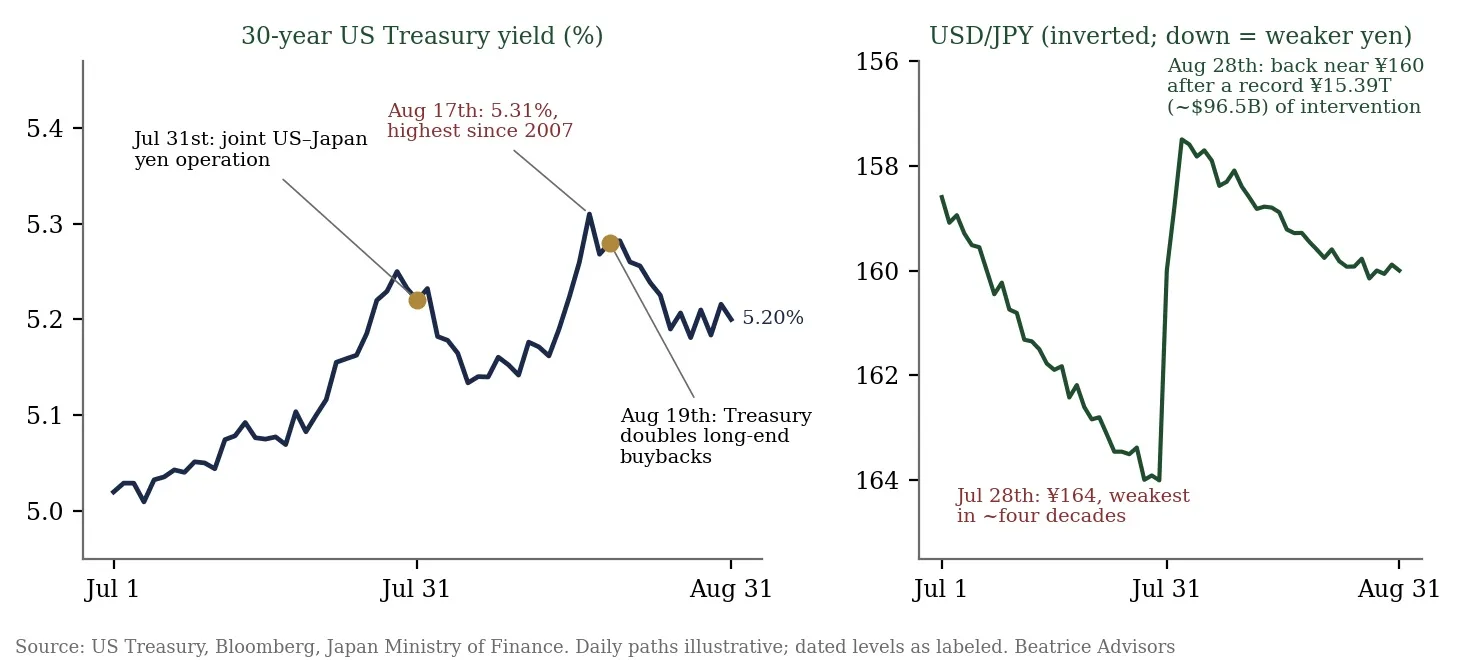
Let’s begin with what July left unfinished. On July 31st the US Treasury and Japan’s Ministry of Finance (MOF) bought yen together, the first coordinated operation since 1998 — the US funding its purchases by selling euros rather than dollars, sparing its own Treasury market, and both governments pointing future operations at the Federal Reserve’s standing repo facility, which lets the Bank of Japan (BOJ) pledge Treasuries for dollar cash rather than sell them. Why would Washington help strengthen someone else’s currency? Because the loop runs through Washington: to defend the yen, Japan sells dollars; to raise dollars, Japan sells US Treasuries; Japan is America’s largest foreign creditor, so its selling lifts US yields, which widens the very rate differential that weakened the yen in the first place. Every yen-defense tool Japan possesses is, structurally, a Treasury-demand-destruction tool — and it is in use: Japan’s reported holdings of US Treasuries fell from roughly $1,225 billion in January to $1,117 billion in June1, more than $100 billion exited in five months. What a rational US should actually want is a weak-but-stable yen, not a weak yen at any price: above roughly ¥160 the regime begins generating the conditions of its own violent end. Joint intervention is regime maintenance, not regime reversal; Washington cannot have both a defended yen and an undiminished Japanese bid for its debt, and its participation is best read as paying a small premium to minimize the size of the destruction. August scored the operation, we believe, and the grade was mixed at best. The MOF disclosed a ¥15.39 trillion campaign — about $96.5 billion, the largest single intervention round on record, bringing 2026 intervention to roughly $170 billion2 — and by month-end the dollar was back near ¥160 anyway. A record intervention bought a month, not a level. The marginal foreign seller went quiet for a few weeks, and then the long end of the US curve broke on its own: the 30-year closed at 5.31% mid-month, its’, highest since 2007. Treasury announced it would at least double its liquidity-support buybacks of 10-to-30-year debt, lifting maximum repurchases in the quarter to $83 billion. A few billion per operation against a roughly $30 trillion market is symbolism, not supply absorption; the market’s response is the point: by week’s end, long yields sat near their pre-announcement levels while the dollar held its decline; gold reached a three-month high, Bitcoin touched $77,000 on its best week in two years, and the euro rose above 1.17 for the first time since May. Moving together — non-sovereign stores of value up, the dollar down, the long end refusing to rally on an official bid — they read as a verdict on the sovereign balance sheet, not a liquidity event. Our The Price of Patience: Why the World’s Long Bonds Broke sets out the drivers and the record of official bond-market interventions; We believe its conclusion applies here — a buyback is a circuit breaker, not a ceiling. In July, the US removed a foreign seller from the long end by lending Japan dollars against its Treasuries; in August, it tried to absorb domestic supply in the same maturities directly. Same pool of capital, same funding-cost defense, two venues. When a government intervenes twice in a month to protect its own borrowing costs, it tells us which kind of stickiness in yields (worsening deficits and term premium) it believes it faces.
Two defenses of US funding costs, one month apart
The 30-year broke to a 19-year high anyway; the yen gave back most of a record intervention
Source: US Treasury, Bloomberg, Japan Ministry of Finance. Daily Paths illustrative; dated levels as labeled. Beatrice Advisors
Washington bought yen in July so that Japan would not sell Treasuries. In August, it bought the Treasuries itself. The market answered by buying gold and bitcoin.
II. Jackson Hole: “A Discipline, not a Decision”
In Fed Chair Warsh’s first Jackson Hole keynote, he declined, once again, to offer forward guidance. “I stand here today committed to a discipline, not to a decision,” he said; the substance was plainer: this summer’s inflation readings, “while better than expected, do not tell me that underlying trends have meaningfully improved.” Markets read it as hawkish: the 2-year yield rose 12 basis points to 4.35%, and the implied odds of a September hike moved from roughly 35% to around 55% — a genuine hike-or-hold now, rather than July’s three-way split. The shape of the move is the analytical content. July’s selloff was a bear steepening — long rates rising faster than short ones, a market demanding more compensation for the future. The post-Jackson Hole week was a bear flattening — short rates rising faster than long ones, a market repricing the Fed’s next move. The two forms of yield stickiness we distinguished in May showed up three weeks apart, in the same curve — the July version malign, the August version, a market that believes the Fed will act on inflation, closer to the benign one. Both leave long rates near two-decade highs (and as I write this, yields for the entire maturity complex, from short to long dated, are higher, flirting with near-term record highs).
PCE (Personal Consumption Expenditures index, the Fed’s preferred gauge of inflation) supplied the context: headline at 3.7% year-over-year, a tenth above consensus; core at 3.3%, in line — now between 3.3% and 3.4% for four consecutive months, with essentially no net progress toward the Fed’s 2% target — and real consumer spending flat. The US credibility trade unwound in a single session on the combination: gold fell 3.7% on the week to $4,506, the dollar index recovered all of its post-buyback decline, and Brent gave back more than 5%.
III. The Inflation Debate, Updated
July’s Consumer Price Index (CPI) printed 3.4% year-over-year with a 0.1% monthly increase and core at 2.5%. Energy did the headline work, falling 1.5% in July after −5.7% in June; core inflation is running at its pre-war pace. Our probability-weighted Beatrice proprietary CPI-U framework, now in its seventeenth iteration³, weights a coerced reopening of the Strait at 45% (oil is the largest driver of inflation), a persistently militarized Strait at 35%, a full resumption of open war at 17%, and a 3% residual, and solves for an average CPI-U of 3.36% for 2026 and 3.03% for 2027. Headline inflation at 3.4% still runs ahead of wage growth at 3.2%, a fourth consecutive month of negative real earnings — the household-level version of the same arithmetic. With the Iran war appearing to escalate into this writing, and the new levels on US 10-year treasuries a benchmark for many American consumer financial products (mortgages, credit cards), we anticipate a nearer term inflation uptick as well as increasing unaffordability for working Americans and consumer pessimism going into 3Q26.
One addition to the inflation ledger from an unexpected direction: tariff talks with Canada collapsed late in the month, and within days 50% US duties on about $20 billion of Canadian goods were in effect, the US had escalated into Canadian autos and parts, and Canada had retaliated in kind against American steel, dairy, appliances, and farm equipment. At this scale, these heightened costs are not additive to our inflation arithmetic. Escalation into potash would be: Canada supplies roughly four-fifths of US potash imports — a material agricultural cost that finds its way into food prices. It is escalation, not the current round that we are watching.
IV. Iran — The Memorandum Lapses
The 60-day memorandum of understanding we described in July as fragile and unsigned expired mid-month with neither side moving to extend it. The escalation that followed was rhetorical first and policy second: the President announced, “economic warfare and isolation on an unprecedented scale” against Iran and any country providing it a financial ‘lifeline’ (a formulation apparently aimed at China), Secretary Bessent promised “the toughest sanctions in history” — and the plan, when it came, underdelivered, holding off on secondary sanctions and recast by the Secretary as a warning shot. Oil traced that arc: Brent fell to $83.55 on reopening talk, rose to $94.39 on the memorandum’s lapse and the rhetoric, and settled at $89.31 once the plan proved lighter than advertised — a second round trip in two months, and both ended near the same place — before the month closed with US strikes on Iran — the first military action since the lapse. The physical picture improved at the margin — Axios, quoting ‘military officials,’ estimates Gulf exports at 8.6–10 million barrels a day against 22–24 pre-conflict, and Iran and Oman agreed to a revenue-sharing framework for the Strait — though Tehran says that implies no immediate reopening, and the Administration will not revive the June agreement’s terms.
Note the confluence of calendar pressures, rather than any single headline. The Strategic Petroleum Reserve (SPR) bottomed at 316.5 million barrels; the release was structured as an exchange, with in-kind repayment at a premium beginning in November, which places a floor near $70 under fourth-quarter crude regardless of what happens in the Strait⁴. Reported munitions shortfalls constrain the military option in the region. Inflation is pressing on a Fed that now leans toward hiking, and higher rates raise the government’s own interest bill. We find it plausible an Administration facing that arithmetic needs an exit more than it needs a victory, and the market’s willingness to sell oil on ‘mediation’ headlines suggests it has drawn the same conclusion.
V. AI — A Vendor Shapes Spender Financing
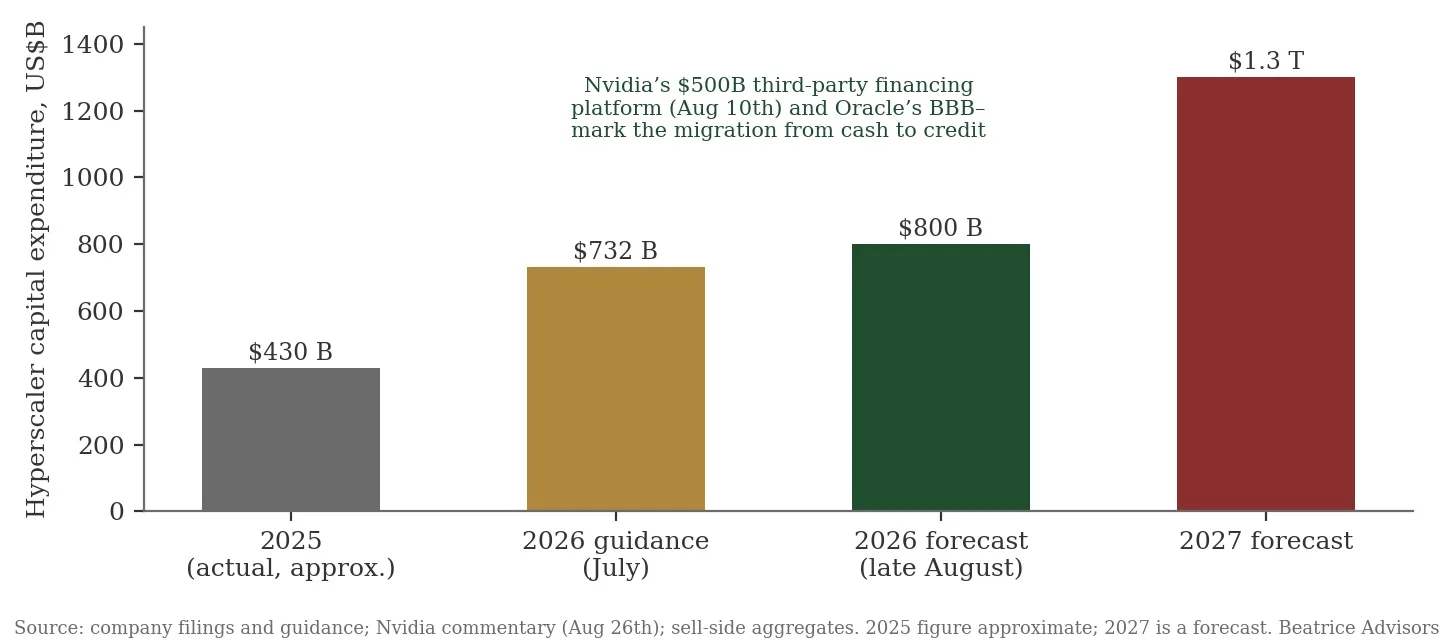
July’s AI question was whether revenue could be tied to spending. August’s question is financing. Nvidia announced a memoranda of understanding with Apollo, BlackRock, Blackstone, Brookfield, Goldman Sachs, and KKR to build independent financing platforms intended to mobilize more than $500 billion of third-party capital for AI infrastructure. The novel part is the mechanism: the platforms contemplate computing power itself as collateral for debt. Jensen Huang’s framing — chips as an ‘investable asset class’⁵ – is an explicit attempt to reprice hardware that markets have always treated as rapidly depreciating; the vendor is now organizing the financing of its customers’ purchases of its own product. That makes the depreciation dispute a credit question rather than an equity one: Nvidia argues 2020-vintage chips still command multi-year commitments; short-seller Michael Burry estimates the large cloud companies are understating AI depreciation by roughly $176 billion across 2026–2028, and July’s accounting asterisk on Microsoft’s extended useful lives is the same dispute from the other side. We see that the gap between a decade of useful life and a potential write-down is now exactly what these lenders must price. Nvidia’s results suggested the demand side: revenue more than doubled year-over-year, a $108 billion current-quarter guide with no China data-center sales assumed, a backlog above $2 trillion, and hyperscaler capital expenditure above $800 billion this year and $1.3 trillion next. Then the tell: Nvidia gave back half its post-earnings gain the next day, and Marvell fell 10% despite beating and raising. The market applied the same criterion it applied in July — the legibility of the revenue against the spending — and the spend has grown faster than the proof. The four hyperscalers guided to $720–745 billion of 2026 capex at the end of July; a month later the sell-side aggregate was above $800 billion, and Oracle’s BBB– bond rating and projected free-cash-flow deficit remain the clearest single datum that the capex is increasingly borrowed. Our research piece, The Bet You Already Own, set out conditions separating an orderly repricing of the AI complex from a disorderly one; one — off-balance-sheet financing acquiring credit characteristics — is now visible. It also sharpens the one-pool-of-capital argument from our 2Q26 Beatrice Buttress: borrowed capex places the AI buildout and the US Treasury on the same side of the market, competing for the same savings, at the moment Japan’s bid for Treasuries is in question.
Hyperscaler capital expenditure: from cash to credit
2026 guidance rose from $720–745B in July to above $800B by late August; 2027 forecast $1.3T
Source: Company filings and guidance; Nvidia commentary (August 26th); sell-side aggregates. 2025 figure approximate; 2027 is a forecast. Beatrice Advisors
VI. The K-Shape of the US Economy
The month’s equity market records coincided with what appeared to be weakening prospects for the American worker. July payrolls showed the economy lost 23,000 jobs against consensus of an 80,000 gain, and the unemployment rate fell to 4.1% — because the participation rate (able Americans choosing to look for work) fell to 61.4%, as nearly 1.4 million people left the labor force this year, not because hiring firmed; the annual benchmark revision removed a further 79,000 jobs. The S&P 500 rose 3.6% that week, its best since mid-April, likely, in part, because the report appeared to take a September hike off the table. Retail sales fell 0.6%, Michigan sentiment sank to 51.0, and real consumer spending was flat. Spring’s condition for the bull case — that growth, not the deficit, is what keeps yields sticky — was tested on both sides: the growth data softened; yields did not. A labor market shedding jobs while the 30-year holds above 5% is not the configuration in which growth is doing the work. August payrolls arrive September 4th and could carry unusual weight.
VII. The Rotation, One Month On
July’s violent rotation — breadth broadening across industries — was followed in August by something quieter. The breadth thread held — Russell 2000 records, energy up roughly 38% year-to-date, community banks still outperforming — but July’s deleveraging cleared and the chip complex bounced hard into Nvidia’s print. Seemingly the forced sellers have left the market, the rotation has paused, and the question we posed in the 2Q26 Buttress — whether mega-cap dominance is structural or temporary — remains open. What has changed since July is that the answer now depends less on earnings, which are exceptional, and more on financing, which is increasingly borrowed.
VIII. Two Trials — One Settles
The States v. Meta — the landmark child-safety case brought by a 29-state coalition, with theoretical damages as high as $1.4 trillion — settled mid-trial. Meta pays up to $17 billion (we find it shockingly small) over ten years and, more consequentially, changes the products: default daily limits and overnight blocks for users under 18, liftable only by a parent; no visible like counts on minors’ posts; a ban on cosmetic-surgery filters; a non-algorithmic feed option; an independent auditor; and an injunction against deceptive safety claims. Terms tighten and payments ratchet up if YouTube, TikTok, and Snap join the framework — and Judge Gonzalez Rogers approved it within hours, resolving 51 attorney-general cases atop March’s New Mexico verdict and abatement order. We described this at year-end 2025 as potentially social media’s tobacco moment; the analogy has now landed literally — a Master Settlement-style framework, with industry-wide opt-ins, thirty years faster than tobacco’s, albeit without tobacco’s existential ramifications. The remaining docket item: Apple’s suit against OpenAI still overhangs the IPO listing now slipped to 2027; allegations remain allegations, but the overhang, and the C-Suite departures around it, are real either way.
IX. For Our Families
What changed in August, and what did not? In July we asked whether the stickiness in long-term yields was benign or malign — growth or deficit? August did not answer, but it shifted the weight of evidence: a record Japanese currency defense that bought a month and not a level; a US Treasury intervening in its own bond market for the first time in this cycle; long-dated US Treasuries that would not rally on that bid, while gold and Bitcoin did; and a labor market that lost jobs while yields held — a reading the jobs report has since revised upward, which strengthens the Fed’s hand more than it settles the growth-versus-deficit question. Those are not the observations of a market being paid to assume a benign path.
But the bull case did not retreat in August; in places it advanced. 2Q26 earnings finished exceptional, Nvidia described demand that overwhelmed any prior cycle, July’s deleveraging left positioning cleaner, and the Fed’s late-month hawkishness is, in its own way, a vote of confidence in the growth it leans against. We believe if demonstrable growth holds yields up, the productivity payoff arrives early, and oil completes its reversion, diversification suggestions will cost some upside — a price we think fair, on our families’ behalf, for resilience across a wider range of outcomes. September is dense — payrolls, the upsized US Treasuries buyback, CPI, the FOMC, and the SPR floor; November’s repayment and midterms beyond.
1. US Treasury, Treasury International Capital (TIC) Major Foreign Holders of Treasury Securities, monthly through June 2026. TIC understates true Japanese ownership held
through Belgian and Luxembourg custodians; the figure is a floor. The next release, September 16th, will show July holdings and likely material additional Japanese selling.
2. Japan Ministry of Finance, Foreign Exchange Intervention Operations (July 30th–August 26th, 2026), released August 28th, 2026. The prior round, April 28th–May 27th,
totaled ¥11.73 trillion. Dollar conversions approximate.
3. Beatrice Advisors US Inflation Scenarios with Geopolitical Risk, 17th Iteration, August 2026. Contact us for access.
4. The exchange structure obliges recipients to return barrels plus a premium of 18–24% beginning November 2026, creating a scheduled buyer at any price. See “Running on
Empty,” peterlupoff.substack.com.
5. Note: some believe ‘compute’ may eventually trade as a commodity.
Disclosures
This analysis is our own. As is our practice, we routinely bring our perspectives to the managers we invest in to test them against the securities-level work they do, and if agreed to, ensure they are expressed in our portfolios through those managers’ hands. Note: we are not making nor would we ever recommend attempting market timing. The historical evidence is unambiguous: disciplined buy-and-hold strategies, rebalancing systematically rather than tactically, has outperformed market timing approaches by substantial margins over every meaningful investment horizon. This research, this writing, is an exercise in preparation.
Investing in securities involves the risk of loss. Past performance is not indicative of or a guarantee of future results. The securities identified and described do not represent all the securities purchased, sold, or recommended for clients’ accounts. The reader should not assume that an investment in the securities identified was or will be profitable. The views expressed herein are those of Beatrice and are subject to change without notice. Indices cannot be invested in directly and are unmanaged. While information in this content comes from reliable sources, no guarantee of accuracy or completeness is provided. The content is not intended as financial advice or a solicitation for securities transactions. Forecasts reflect current conditions, may change, and are not assured to occur. This material is intended for informational purposes only and should not be construed as personalized or individualized investment advice. Please contact your Beatrice representative if you have any questions or your investment situation has changed.


